Assessment Tasks
Digital EMA@School consists of a set of structured assessment tasks designed to measure foundational numeracy constructs across early grades. Each task is aligned to empirically supported subdomains of number sense and early operations and measures a specific foundational skill that research shows is predictive of mathematical development.
To ensure conceptual coherence and developmental progression, the tasks are organized into three primary domains that reflect core dimensions of early numeracy: Symbols, Relations, and Operations. Together, these domains provide a structured and research-informed framework for capturing how students understand numbers, how they relate numbers to one another, and how they operate on numerical quantities.
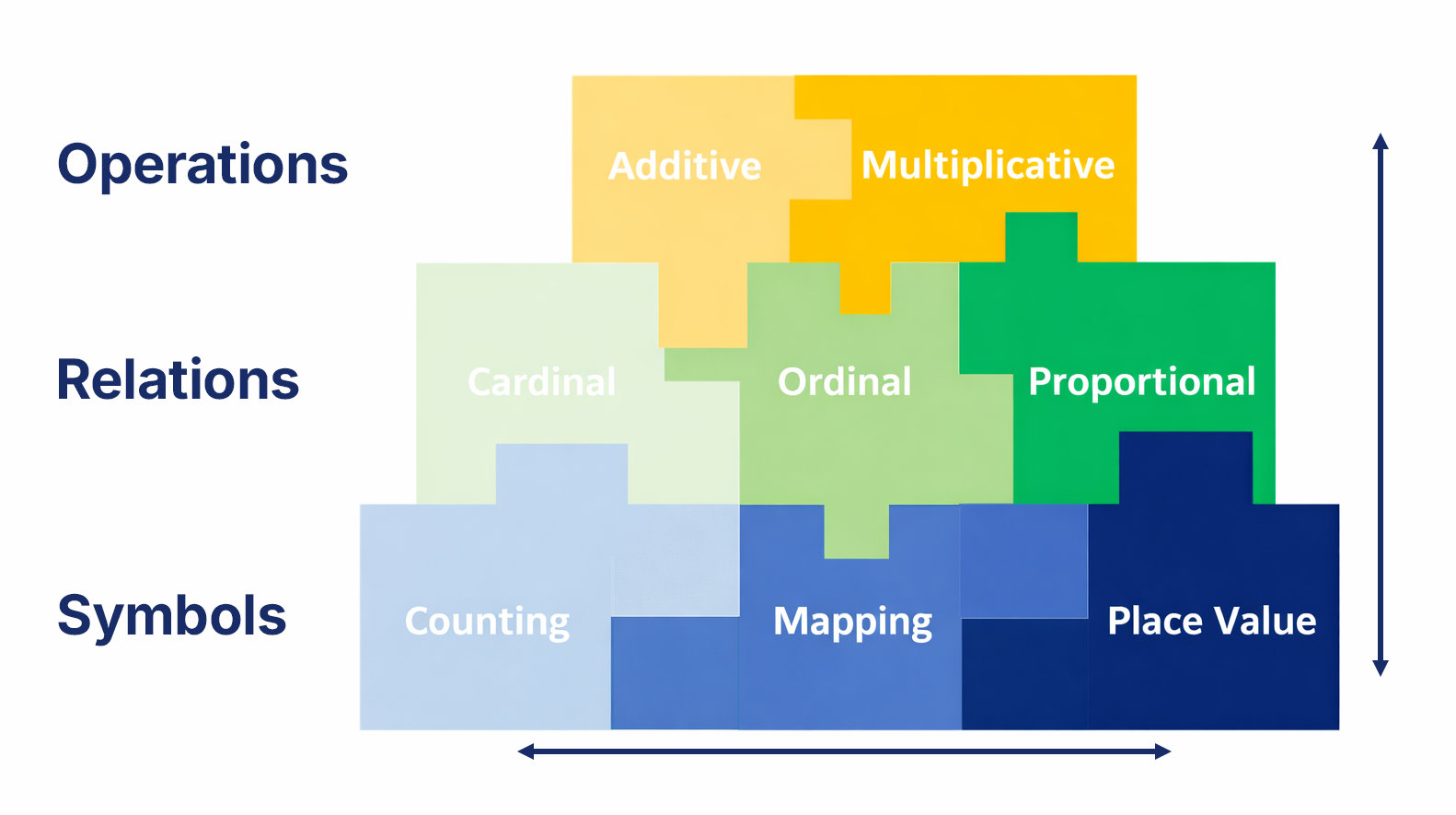
(Source: https://carleton.ca/arc/about-the-ema-dema/)
Symbols
The Symbols domain assesses foundational counting and symbolic number understanding in the early grades. These tasks measure children's ability to produce number sequences, map symbols to quantities, and construct numbers using place value.
In Kindergarten and Grade 1, this domain reflects core counting principles, including stable order, one-to-one correspondence, cardinality, and abstraction, which are considered essential prerequisites for later mathematical reasoning.
In higher grades, knowledge of mathematical symbols other than numbers, and rational number symbols (i.e., decimals, fractions) are assessed.
Verbal Counting
Kindergarten–Grade 1Students count aloud in sequence from a given starting point. The task records the highest correct number reached and identifies any breakdowns in the counting sequence.
Dot Counting
KindergartenStudents count a visually presented set of dots arranged in varied spatial configurations and report the total quantity.
Next Numbers
Grade 1Students extend a number sequence by identifying the next number(s) based on the underlying rule or pattern.
Number Naming
Kindergarten–Grade 1Students identify and verbally name numerals presented visually, including single- and multi-digit numbers.
Number Writing
Grades 1–4Students write numerals in response to spoken number words using a structured digital input interface.
Symbol Knowledge
Grades 5–6Students identify mathematical symbols (e.g., "<") in response to auditory prompts.
Relations
Relations refers to students' understanding of how numbers compare, order, and relate to one another within a numerical system. This domain assesses magnitude reasoning, ordinal understanding, sequencing, and pattern recognition, reflecting the development of mental number line representations and early algebraic thinking.
Number Comparison
Kindergarten–Grade 3Students compare two numerals and identify which represents the larger quantity.
Number Order
Grades 3–4Students arrange numbers in ascending or descending order and explain their relative positions using comparison language and number relationships.
Number Line
Kindergarten–Grade 4Students place a target number on a number line. The numerical range varies by grade level.
Operations
Operations refers to students' understanding of how numbers can be combined, separated, and transformed through arithmetic processes. This domain assesses conceptual understanding and procedural fluency in addition, subtraction, multiplication, and division, including part–whole reasoning, decomposition and recomposition of numbers, and the development of efficient and accurate calculation strategies.
Arithmetic Fluency
Grades 1–4Students solve addition, subtraction, multiplication, and division problems under timed conditions to measure speed, accuracy, and efficiency.
Equations
Grades 3–4Students solve simple equations with a missing value to make both sides equal, using their understanding of number relationships and operations.
Calculations
Grade 4Students solve multi-digit addition and subtraction problems using vertically aligned input fields that emphasize place value positions.
Rational Numbers
Grade 4Students respond to conceptual fraction items, including number line placement and fraction comparison tasks.
Practice Questions
Every domain begins with purpose-built practice questions that familiarize students with the task format and interaction mechanics before scored items begin. The specific purpose of each practice question differs from domain to domain and has been carefully designed by the research team.
Practice items are clearly distinguished from scored items in all reports and data exports, ensuring that only assessment items contribute to performance metrics.
See the Full Assessment Experience
Teachers can preview the complete student assessment experience, including all domains and practice questions, through the Student Test Walkthrough Video.
Watch the Walkthrough →Tasks by Grade Level
| Task | K | G1 | G2 | G3 | G4 | G5 |
|---|---|---|---|---|---|---|
| Symbols | ||||||
| Dot Counting | ✓ | |||||
| Verbal Counting | ✓ | ✓ | ||||
| Number Naming | ✓ | ✓ | ||||
| Next Numbers | ✓ | |||||
| Number Writing | ✓ | ✓ | ✓ | ✓ | ✓ | |
| Symbol Knowledge | ✓ | ✓ | ||||
| Relations | ||||||
| Number Lines | ✓ | ✓ | ✓ | ✓ | ✓ | ✓ |
| Number Comparison | ✓ | ✓ | ✓ | ✓ | ||
| Number Order | ✓ | ✓ | ||||
| Rational Numbers | ✓ | ✓ | ||||
| Operations | ||||||
| Addition Fluency | ✓ | ✓ | ✓ | |||
| Subtraction Fluency | ✓ | ✓ | ✓ | |||
| Combined Addition/Subtraction | ✓ | |||||
| Equations | ✓ | ✓ | ✓ | |||
| Combined Multiplication/Division | ✓ | ✓ | ||||
| Calculation | ✓ | ✓ | ||||